There will be no marriage in heaven.
According to Matthew 22:30, Luke 20:34-36 and Mark 12:22-25, in heaven we won’t get married or be given in marriage. Why?
For context, Jesus said those words in response to the Sadducees, who did not believe in eternal life, who tried to make their case that there is no resurrection. But Jesus turned it around on them, and made a point about what heaven is like instead.
The Sadducee argument was basically this: Suppose someone was married many times, all marriages ending in widowing. This person and all of their partners get resurrected in eternity. Who are they now really married to? The absurdity of imagining someone trying to deal with suddenly having a huge number of spouses in heaven was their case that there cannot be a heaven.
But let’s assume that they were wrong, that Jesus was right, and that there is eternal life. Why is there no marriage in heaven?
The Sadducee’s had the understanding that marriage is a law. Like the Law of Moses which is a covenant (binding agreement) between God and the Jews, marriage is also a covenant.
You can see in Romans 7:1-2 that Paul had the same view that marriage is a law, binding until the death of one spouse.
But that’s not all that marriage entails in the Christian worldview. Going back to Genesis 2:24 the Bible says this (NIV):
“That is why a man leaves his father and mother and is united to his wife, and they become one flesh.”
So within a relationship that includes the covenant / law of marriage, we also see a union between a man and woman which goes so deep that they are called one flesh. They are inseparable in some sense, two individuals become a single individual entity in this type of relationship.
Hmm so does that mean all I have to do to have this depth of relationship with someone is go to a church, pay a guy to do a ceremony, get a paper and hey presto we are one flesh?
no.
What the law of marriage is really meant to do is to establish that there is a covenant between two people. The desire and need for it arises from the nature of the relationship between two people. The law of marriage can’t create the relationship, but it’s an important part of it. Even arranged marriages don’t create a relationship- the partners have to make it work and own the marriage, and build their trust, intimacy, desire, just the same.
What I’m saying is that there is a reality of a union, a one-flesh relationship, that cannot be created by the law alone, but the law of marriage makes it possible. I’ll illustrate why:
Marriage is pointless without love. If you disagree you can stop reading because I won’t justify that statement. Marriage is pointless without love.
But what is Love?
Love is a big deal. 1 Corinthians 13 talks about what Love is, and that Love is an eternal quality. All kinds of things pass away, but Love remains. So when we’re talking about this kind of love, we are talking about something eternal, something heavenly, that will not fade when this world, or our own lifetime fades.
What is Love practically? According to Paul, love is patient, kind, selfless, honest, protecting, trusting, hoping and enduring, amongst other aspects.
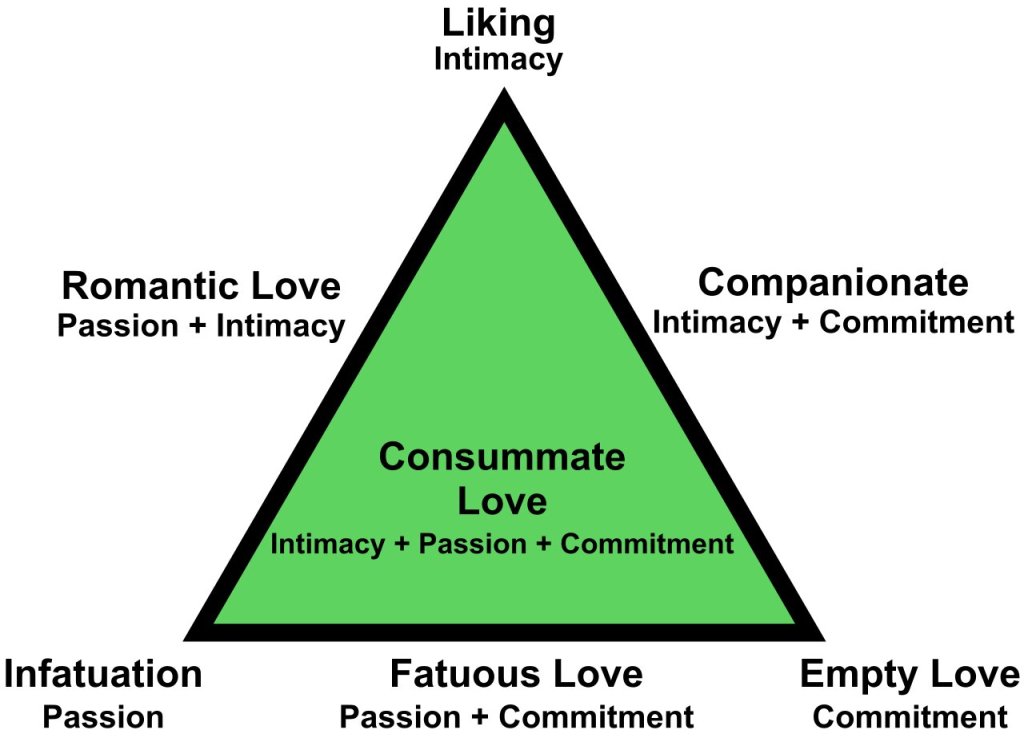
There is a great model for Love based on 3 dimensions. It is called the triangular theory of love, developed by psychologist Robert Sternberg in 1986. (not to be confused with love triangles, which do not belong anywhere near a marriage).
Love has 3 dimensions: Intimacy, Passion and Commitment.
Depending on which of these are present, we get different types of love. If none of them are present, we get non-love, if only passion is present we get infatuation, if there is only intimacy and commitment, we get friendship and so on.
All three together are called Consummate Love, and by definition it involves Passion and Intimacy, but is also only possible for a committed couple.
Intimacy can be built over time, as we get to know and trust people in our lives, Passion may even arise spontaneously from just seeing someone, but how can we have full Commitment in a world where so many factors are against it?
In reality, people fail miserably at staying committed. In the US, roughly 45% of marriages end in divorce. In Australia it’s about the same, at 43%. That’s a lot, and you might hear people quote this fact, saying that about half of marriages fail. Which is not wrong.
However…
That’s not because marriage somehow dooms relationships to fail. In fact, of non-married relationships, far more split apart. But it just isn’t as big news. Divorces have to get filed, and so there are plenty of statistics. But ask yourself if you can think of any examples of people who only lived together, or were in “stable” sexual relationships for a period of time, that then split up. I can think of many examples. Statistics are harder to find, but a rough estimate can be made from data on lifetime sexual partners:
Based on studies conducted at the University of Chicago, 1994, and consistent with more recent research, the vast majority of sex happens in stable relationships, contrary to media messaging. The average lifetime sexual partners (US) are somewhere between 2 and 10, but 8 is a good estimate. So about 6 of these can be estimated as being sexual partners within stable relationships. It’s safe to make this estimate because the proportion of people who have large numbers of sex partners (and who would favour casual sex) is small. So roughly speaking, at least 5 of these 6 relationships did not last, otherwise there would not have been a sixth… So a good guess would be that at an absolute minimum about 5 of 6 non-married relationships fail, which would be 83 %. This is all very rough estimating, but it might help illustrate that the number of non-married relationships which fail is super high.
So at minimum, about twice as many relationships fail when the partners were not married.
That would make sense, because if there is less commitment, there is by definition less holding the relationship together.
But why do the vast majority of all relationships separate, and why do a large proportion of supposedly committed marriage relationships end in divorce?
When left alone, things will fall apart.
The basic tendency of the world is towards entropy. This is a concept from physics, which says that things will always tend to break down. So at the core of our current reality there is this force which makes things disintegrate, become less structured. Order descends into Chaos.
The basic spiritual state of the world is similarly affected by Sin. Sin destroys good things, it wears them down over time, and disintegrates them. The Bible repeatedly states that Sin leads to destruction.
It takes some kind of effort to work against this. It sure took Jesus a lot of effort, and it takes us a faith in Jesus which transforms our minds, our lives and our actions.
Time for a crash course on the relationship between faith and work:
I believe that my desk chair supports my weight. I live my life in a way that treats this belief as real. It makes me act in a way which has faith in it- I trust the chair will support my weight, so I sit on it. If anyone asked me about whether or not the chair supports my weight, I would tell them, that, yes, it does. My belief is integrated with my words and my actions.
Imagine I said I believed that the chair supports me, but I never actually sit on it, and instead awkwardly stand at my desk. Something’s wrong, right?
Also, imagine that I sit on it all the time, but if anyone asked me if the chair supports my weight I tell them that it doesn’t. Something’s also seriously wrong here, right?
That’s the book of James in a nutshell- faith without works is dead. If you don’t actually live by something you believe, then it is meaningless to say you believe it. End of crash course.
So now let’s see how this applies directly to our issue of Sin and its effects on Love relationships.
In Genesis 3:19, after the Fall, in a world where the effects of Sin are present, Adam is told that from now on, he will have to work hard to live, to produce food. Without the hard work, thorns and thistles take over. However, with work, he can produce food, and the reward is great.
This passage can be seen as casting work in a negative light, as a necessary evil, or a curse. However it is not work that is the curse, but work is what is needed to overcome the curse.
The ground is cursed, the conditions are cursed (i.e. Sin is present and its effects make life harder), but work can transform those conditions into conditions that sustain life.
What all this means for our discussion on Love is this: All good things require work. Consummate love has to be worked for on this earth, but the rewards are great.
By the way, activities involving work, or effort, of a physical or mental nature, are actually the most rewarding activities. People are most satisfied when they are working, being challenged and growing to meet challenges with skill. The least rewarding activities are passive activities involving no work, like watching television. People report the lowest levels of satisfaction during such activities. (for a great book exploring this concept, read Flow by Mihaly Csikszentmihalyi)
As a side note, I think good things can be received as blessings, and even come out of nowhere, with no work necessary. It isn’t that we earn good things by working for them, it is rather that we are given good things, but if we grow complacent and do not put in effort then the good things we do have will disintegrate. (Compare this with Jesus’ parable of the talents, for example)
If we don’t pay careful attention to something, we will lose it.
In our relationships it’s like this: Without voluntary effort, the destructive forces of the world will eventually end up destroying love. Some types of sin that can break down a marriage include negligence, laziness, envy, adultery, misplaced lust, misplaced trust, idolatry, lack of self-control, anger, drunkenness, the list is endless. I think little imagination is required to see how sins like these can lead to the destruction of a marriage.
If none of these sinful forces were around, we wouldn’t need anything to safeguard us from them.
If there was no Sin, the Israelites wouldn’t have been given the Law, and Jesus wouldn’t have lived, taught, and conquered death. But because Sin is still around, we need covenants, officially recognised bonds of commitment, both between us and God, as well as amongst ourselves.
Marriage, witnessed by people, before God, is an institution, a covenant. To the extent that we take the marriage vows seriously, they keep us committed. In this way, marriage helps safeguard against Sin destroying the Commitment aspect in our Love relationship.
On top of that, marriage creates a space where Intimacy and Passion can flourish. Through the covenant of marriage, a safety net is introduced which grows our ability to be intimate and passionate with our partner.
In terms of Passion, married men report much higher levels of sexual satisfaction, the same is true for women, who are additionally about ten times likelier to have orgasms in married sex than unmarried sex. Anyone who thinks marriage is not in the best interest of women should think about that one for a bit. For both sexes, the marriage commitment and the deeper trust, enables more intense Passion.
Intimacy-wise, there’s also the unique chance of having an amazing friendship with our marriage partner. You will probably (hopefully!) end up spending the most amount of time with your spouse compared to anyone else, so it’s up to you whether that time is good, bad or amazing. By actively working to shape those times together, the couple can build an intimate relationship that flourishes.
None of these things happen by chance, they are a combination of the starting conditions of our relationship, for example whether we are compatible in terms of our worldviews, priorities, attraction to each other, and so forth, but also how we choose to shape our relationship.
I suspect for those couples caught in a limbo of indecision on whether or not the partner is the right one for them, that the missing piece lies in the decision to either walk away or to commit and put in the work, rather than what the starting conditions of the relationship are.
So we’ve established that marriage provides the best opportunity on earth to experience and live in Consummate Love, to live all dimensions of Love to the fullest. Marriage enables us to be Intimate, Committed and Passionate with someone. It’s undoubtedly a wonderful thing.
Now the law of marriage exists to protect this underlying Love relationship ofone-fleshUnity and Consummate Love. The law, the institution, the paper, the ceremony, they are only important inasmuch as the marriage commitment enables the one flesh relationship.
To recap, the marriage covenant provides a means of having a one flesh Consummate Love relationship, with full commitment, despite the sinful state of the world.
Just like an umbrella is only needed while there is rain, marriage is only needed while there is Sin.
So marriage is a beautiful thing, but we won’t need it anymore in heaven.
…
“Three things will last forever—faith, hope, and love—and the greatest of these is love.”
1 Corinthians 13:13 (NLT)
…
 Warm Yellow Glow
Leave a comment