-
A Safe Place
this quick post elaborates on the following quote from Jordan Peterson:
“Do You Really Want a Safe Place? Is that what you want?
You want to be so weak that you are protected from threats? What the hell kind of life is that? You are a paralyzed rabbit in a hole. That is no life for a human being.
You should be confronting danger and the unknown and malevolence. The reason for that is: The solution to the problem of tragedy and malevolence is the willingness to face them now.
… Because the more you confront the two of them, the more you grow, and maybe you can grow so that you are actually larger than the chaos and malevolence itself…”
To which I would add that we can have a safe place, but one that we take wherever we go. A safe place that does not depend on circumstances around us, a place where we have peace beyond understanding. It is in God, it is the armor of God, which is Jesus, and He is larger than all chaos and malevolence. -
Amazing Grace
I once was lost
But now I’m found
I once was blind but thought I could see
But now I know I am blind and need His voice to guide me
I once was hurt and resentful for injuries in my past
But now I am healed by the touch of Jesus
I once was needy and looked for my needs to be filled by other humans
But now I find all my needs met in Jesus
I once feared losing what I care about the most
But now I know that the Father holds it in His hands
I once built my kingdom
But now I build the Kingdom of God
I once gave 10% to God
But now I receive 100% from God
I once spent 20 minutes a day being transformed by Christ
But now I want my whole life to be transformation into His likeness
I once held up Faith by the power of my mind
But now Faith powers my whole life, including my mind
I once thought I could give from the well of my love
But now I come to the living water, to be filled to overflow
I once held on as tight as I could
But now I wait for gifts that I may hold gently, knowing they belong to God
I once looked for approval from people
But now I give fear of man to Jesus, and care about his opinion of me
I once had anxiety around Christians I disagreed with
But now I have peace knowing that Jesus is who He is regardless of anything the great I AM
I once served many masters
But now I am free in serving just the Lord
I once needed to plan and set goals of my own, without the Shepherd
But now my Shepherd has full leadership
I once tried to fit service to Jesus into my own plans
But now all of life serves Him
I once looked into my darkness to try and fix it with just the right kind of light
But now I look to the Light, and the darkness disappears
I once tried to understand everything
But now I am like a little child
I once was informed, but still conformed to the pattern of the world
But now I am being transformed by the renewing of my mind
I once looked out for my own interests and tried to balance those with others
But now I am part of the community of faith
I once studied all kinds of science and then told all kinds of stories
But now I want to study and tell the greatest Story there is
I once didn’t have clear directions for myself
But now I’m back in the arms of my Shepherd
I once heard so many voices calling out
But now I listen to the voice of my Shepherd
How Sweet the Sound
-
True Worship
When we are home we will all truly worship
but we may still find others along the way
who come before Jesus sincerely
who care about spirit and truth
who seek intimacy and honest surrender
and find their joy in the Lord, not man
.
One day on my journey I met just such a person
who worshipped with me on my way
who comes before Jesus sincerely
who yearns for the spirit of truth
who seeks to surrender to Jesus
and now, my Jesus, I understand.
.
Dedicated to someone who truly worshipped with me on our journey home. My friend, one day we will worship together again. How easy it seems to be for Christians to forget how special worship is, and to treat it lightly. Let us not treat it that way, ever. If we do, we treat Jesus frivolously. That’s a real shame. Especially because our whole life can be an act of worship… I’ll write some more about whats been happening in my heart soon but just thought I’d share something with you folks for now. Thanks for reading, I appreciate you.
-
Why marriage is not forever.
There will be no marriage in heaven.
According to Matthew 22:30, Luke 20:34-36 and Mark 12:22-25, in heaven we won’t get married or be given in marriage. Why?
For context, Jesus said those words in response to the Sadducees, who did not believe in eternal life, who tried to make their case that there is no resurrection. But Jesus turned it around on them, and made a point about what heaven is like instead.
The Sadducee argument was basically this: Suppose someone was married many times, all marriages ending in widowing. This person and all of their partners get resurrected in eternity. Who are they now really married to? The absurdity of imagining someone trying to deal with suddenly having a huge number of spouses in heaven was their case that there cannot be a heaven.
But let’s assume that they were wrong, that Jesus was right, and that there is eternal life. Why is there no marriage in heaven?
The Sadducee’s had the understanding that marriage is a law. Like the Law of Moses which is a covenant (binding agreement) between God and the Jews, marriage is also a covenant.
You can see in Romans 7:1-2 that Paul had the same view that marriage is a law, binding until the death of one spouse.
But that’s not all that marriage entails in the Christian worldview. Going back to Genesis 2:24 the Bible says this (NIV):
“That is why a man leaves his father and mother and is united to his wife, and they become one flesh.”
So within a relationship that includes the covenant / law of marriage, we also see a union between a man and woman which goes so deep that they are called one flesh. They are inseparable in some sense, two individuals become a single individual entity in this type of relationship.
Hmm so does that mean all I have to do to have this depth of relationship with someone is go to a church, pay a guy to do a ceremony, get a paper and hey presto we are one flesh?
no.
What the law of marriage is really meant to do is to establish that there is a covenant between two people. The desire and need for it arises from the nature of the relationship between two people. The law of marriage can’t create the relationship, but it’s an important part of it. Even arranged marriages don’t create a relationship- the partners have to make it work and own the marriage, and build their trust, intimacy, desire, just the same.
What I’m saying is that there is a reality of a union, a one-flesh relationship, that cannot be created by the law alone, but the law of marriage makes it possible. I’ll illustrate why:
Marriage is pointless without love. If you disagree you can stop reading because I won’t justify that statement. Marriage is pointless without love.
But what is Love?
Love is a big deal. 1 Corinthians 13 talks about what Love is, and that Love is an eternal quality. All kinds of things pass away, but Love remains. So when we’re talking about this kind of love, we are talking about something eternal, something heavenly, that will not fade when this world, or our own lifetime fades.
What is Love practically? According to Paul, love is patient, kind, selfless, honest, protecting, trusting, hoping and enduring, amongst other aspects.
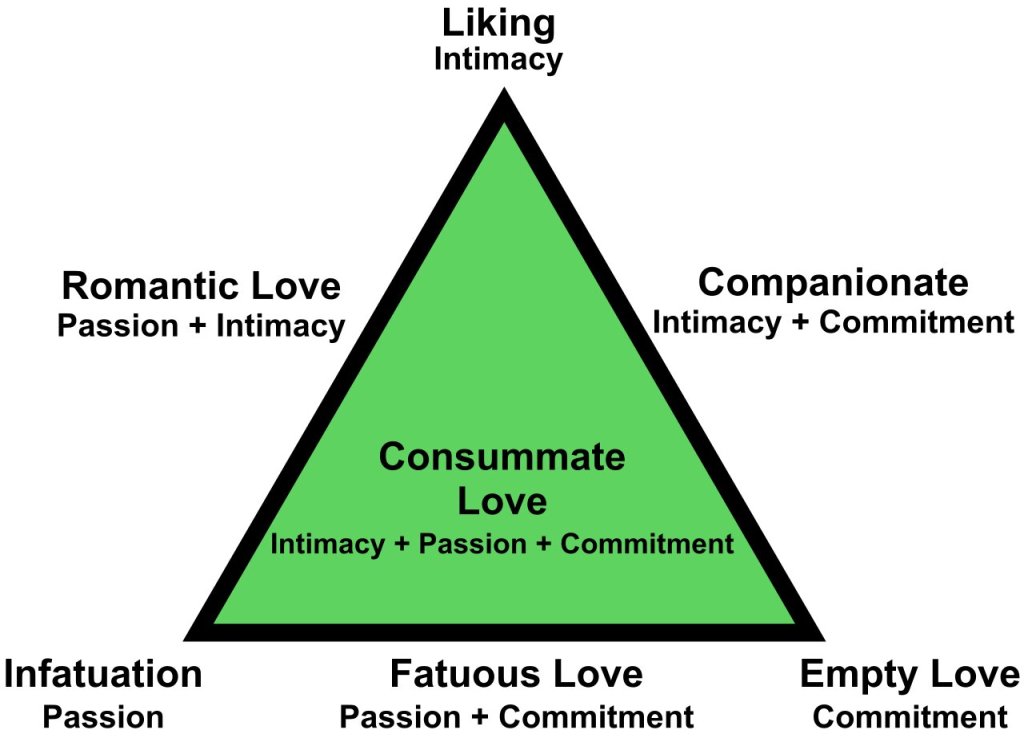
Sternberg’s Triangular Model of Love There is a great model for Love based on 3 dimensions. It is called the triangular theory of love, developed by psychologist Robert Sternberg in 1986. (not to be confused with love triangles, which do not belong anywhere near a marriage).
Love has 3 dimensions: Intimacy, Passion and Commitment.
Depending on which of these are present, we get different types of love. If none of them are present, we get non-love, if only passion is present we get infatuation, if there is only intimacy and commitment, we get friendship and so on.
All three together are called Consummate Love, and by definition it involves Passion and Intimacy, but is also only possible for a committed couple.
Intimacy can be built over time, as we get to know and trust people in our lives, Passion may even arise spontaneously from just seeing someone, but how can we have full Commitment in a world where so many factors are against it?
In reality, people fail miserably at staying committed. In the US, roughly 45% of marriages end in divorce. In Australia it’s about the same, at 43%. That’s a lot, and you might hear people quote this fact, saying that about half of marriages fail. Which is not wrong.
However…
That’s not because marriage somehow dooms relationships to fail. In fact, of non-married relationships, far more split apart. But it just isn’t as big news. Divorces have to get filed, and so there are plenty of statistics. But ask yourself if you can think of any examples of people who only lived together, or were in “stable” sexual relationships for a period of time, that then split up. I can think of many examples. Statistics are harder to find, but a rough estimate can be made from data on lifetime sexual partners:
Based on studies conducted at the University of Chicago, 1994, and consistent with more recent research, the vast majority of sex happens in stable relationships, contrary to media messaging. The average lifetime sexual partners (US) are somewhere between 2 and 10, but 8 is a good estimate. So about 6 of these can be estimated as being sexual partners within stable relationships. It’s safe to make this estimate because the proportion of people who have large numbers of sex partners (and who would favour casual sex) is small. So roughly speaking, at least 5 of these 6 relationships did not last, otherwise there would not have been a sixth… So a good guess would be that at an absolute minimum about 5 of 6 non-married relationships fail, which would be 83 %. This is all very rough estimating, but it might help illustrate that the number of non-married relationships which fail is super high.
So at minimum, about twice as many relationships fail when the partners were not married.
That would make sense, because if there is less commitment, there is by definition less holding the relationship together.
But why do the vast majority of all relationships separate, and why do a large proportion of supposedly committed marriage relationships end in divorce?
When left alone, things will fall apart.
The basic tendency of the world is towards entropy. This is a concept from physics, which says that things will always tend to break down. So at the core of our current reality there is this force which makes things disintegrate, become less structured. Order descends into Chaos.
The basic spiritual state of the world is similarly affected by Sin. Sin destroys good things, it wears them down over time, and disintegrates them. The Bible repeatedly states that Sin leads to destruction.
It takes some kind of effort to work against this. It sure took Jesus a lot of effort, and it takes us a faith in Jesus which transforms our minds, our lives and our actions.
Time for a crash course on the relationship between faith and work:
I believe that my desk chair supports my weight. I live my life in a way that treats this belief as real. It makes me act in a way which has faith in it- I trust the chair will support my weight, so I sit on it. If anyone asked me about whether or not the chair supports my weight, I would tell them, that, yes, it does. My belief is integrated with my words and my actions.
Imagine I said I believed that the chair supports me, but I never actually sit on it, and instead awkwardly stand at my desk. Something’s wrong, right?
Also, imagine that I sit on it all the time, but if anyone asked me if the chair supports my weight I tell them that it doesn’t. Something’s also seriously wrong here, right?
That’s the book of James in a nutshell- faith without works is dead. If you don’t actually live by something you believe, then it is meaningless to say you believe it. End of crash course.
So now let’s see how this applies directly to our issue of Sin and its effects on Love relationships.
In Genesis 3:19, after the Fall, in a world where the effects of Sin are present, Adam is told that from now on, he will have to work hard to live, to produce food. Without the hard work, thorns and thistles take over. However, with work, he can produce food, and the reward is great.
This passage can be seen as casting work in a negative light, as a necessary evil, or a curse. However it is not work that is the curse, but work is what is needed to overcome the curse.
The ground is cursed, the conditions are cursed (i.e. Sin is present and its effects make life harder), but work can transform those conditions into conditions that sustain life.
What all this means for our discussion on Love is this: All good things require work. Consummate love has to be worked for on this earth, but the rewards are great.
By the way, activities involving work, or effort, of a physical or mental nature, are actually the most rewarding activities. People are most satisfied when they are working, being challenged and growing to meet challenges with skill. The least rewarding activities are passive activities involving no work, like watching television. People report the lowest levels of satisfaction during such activities. (for a great book exploring this concept, read Flow by Mihaly Csikszentmihalyi)
As a side note, I think good things can be received as blessings, and even come out of nowhere, with no work necessary. It isn’t that we earn good things by working for them, it is rather that we are given good things, but if we grow complacent and do not put in effort then the good things we do have will disintegrate. (Compare this with Jesus’ parable of the talents, for example)
If we don’t pay careful attention to something, we will lose it.
In our relationships it’s like this: Without voluntary effort, the destructive forces of the world will eventually end up destroying love. Some types of sin that can break down a marriage include negligence, laziness, envy, adultery, misplaced lust, misplaced trust, idolatry, lack of self-control, anger, drunkenness, the list is endless. I think little imagination is required to see how sins like these can lead to the destruction of a marriage.
If none of these sinful forces were around, we wouldn’t need anything to safeguard us from them.
If there was no Sin, the Israelites wouldn’t have been given the Law, and Jesus wouldn’t have lived, taught, and conquered death. But because Sin is still around, we need covenants, officially recognised bonds of commitment, both between us and God, as well as amongst ourselves.
Marriage, witnessed by people, before God, is an institution, a covenant. To the extent that we take the marriage vows seriously, they keep us committed. In this way, marriage helps safeguard against Sin destroying the Commitment aspect in our Love relationship.
On top of that, marriage creates a space where Intimacy and Passion can flourish. Through the covenant of marriage, a safety net is introduced which grows our ability to be intimate and passionate with our partner.
In terms of Passion, married men report much higher levels of sexual satisfaction, the same is true for women, who are additionally about ten times likelier to have orgasms in married sex than unmarried sex. Anyone who thinks marriage is not in the best interest of women should think about that one for a bit. For both sexes, the marriage commitment and the deeper trust, enables more intense Passion.
Intimacy-wise, there’s also the unique chance of having an amazing friendship with our marriage partner. You will probably (hopefully!) end up spending the most amount of time with your spouse compared to anyone else, so it’s up to you whether that time is good, bad or amazing. By actively working to shape those times together, the couple can build an intimate relationship that flourishes.
None of these things happen by chance, they are a combination of the starting conditions of our relationship, for example whether we are compatible in terms of our worldviews, priorities, attraction to each other, and so forth, but also how we choose to shape our relationship.
I suspect for those couples caught in a limbo of indecision on whether or not the partner is the right one for them, that the missing piece lies in the decision to either walk away or to commit and put in the work, rather than what the starting conditions of the relationship are.
So we’ve established that marriage provides the best opportunity on earth to experience and live in Consummate Love, to live all dimensions of Love to the fullest. Marriage enables us to be Intimate, Committed and Passionate with someone. It’s undoubtedly a wonderful thing.
Now the law of marriage exists to protect this underlying Love relationship ofone-fleshUnity and Consummate Love. The law, the institution, the paper, the ceremony, they are only important inasmuch as the marriage commitment enables the one flesh relationship.
To recap, the marriage covenant provides a means of having a one flesh Consummate Love relationship, with full commitment, despite the sinful state of the world.
Just like an umbrella is only needed while there is rain, marriage is only needed while there is Sin.
So marriage is a beautiful thing, but we won’t need it anymore in heaven.
…
“Three things will last forever—faith, hope, and love—and the greatest of these is love.”
1 Corinthians 13:13 (NLT)
…
-
How to Train your Doggo
I enjoy training dogs. Training dogs is a useful process, and a creative process, but it also creates order where otherwise there would be chaotic behaviour. By training a dog, you help the dog to function in a way that aligns with the requirements that are inherent to its life among people.
But does training the dog destroy its identity? By training a dog, a human changes its behaviour, modifies its personality and creates a different kind of animal. A dog without training (formal training or “on-the-job” training just by being around people) would not be able to live easily with most people. Dogs hunt, they can bite, they go to the bathroom where they shouldn’t, and generally don’t fit with what we do.
But are we any different? After all, we get trained as children, and our behaviour gets modified by our parents and others, in a way that makes us fit with what they do. And that’s called parenting, and socialisation, and so on. We tend to think of it as positive. But some would suggest that we risk destroying the identity of a child by raising it to conform with our expectations. Of course, there is good and bad parenting, and everything in between. But generally, a child is better suited to life if it has been raised well, so it seems like a good thing to do.
In parenting, and in training dogs, there is a conception of what the subject of our training could become, and then we work towards that. It doesn’t have to be an imposition, every child, and every dog has a unique nature, so we work with that, and help to shape it in a way that allows it to flourish, but also works well with our life.
If a dog is well-trained, and waits for its daily walk or run, rather than barking and biting to get what it wants, then its human is more likely to take it for a walk. Of course the human has to show up for the dog consistently. That’s part of looking after and training the animal, you have to do a good job of it. And if a dog doesn’t make you annoyed all the time because it’s doing things you don’t want it to (like eating pillows, sleeping on your bed, or whatever you don’t like) then the dog will get better treatment too, because you won’t feel the need to vent your anger on it actively or passive-aggressively.
Same exact story for kids- if they enrich your life, you treat them well, if they’re a source of frustration, you’ll take it out on them.
So it is better for both the dog and the owner, if the dog is trained. The dog becomes something more than it would otherwise be, not just something different. New ways of living and new experiences are opened up to it. It gets the joys of playing with humans, having a safe home, free food, free healthcare, a longer life-expectancy, skills development and intellectual challenge. That is, of course, if it’s in a good home. The dog gets the privilege of companionship with humans. The dog is elevated from just being an ordinary, natural, dog. It becomes a pet.
Maybe the same can be said for human beings in relationship with God. We have both the challenge and privilege of becoming something more than we otherwise could be. We are elevated from being, ordinary, natural Man, to being the New Man. The second Adam. The transformational journey of Christianity is like a doggo being trained to become a pet. It’s not always easy, but by allowing God to train us we become a type of Being that can flourish not just in our “natural” habitat, but in the home of God. And we get new ways of thinking, seeing, experiencing, feeling, and a new life. We get the privilege of companionship with our Creator, who created our natural self, and works with us to create and shape our eternal self, as well. The joys of this process, and the way of life that it opens up are beyond what we can understand before we are transformed. But as we are transformed, we see clearer, and experience more of what living with God is like.
The way life will be once that transformation is complete, that’s something worth imagining and dreaming about- that’s the “life of the age to come” the New Testament speaks of…
2 Corinthians, towards the end of chapter 5 says the following, regarding what is happening to Christians because of what Jesus has done:
” …those who receive his new life will no longer live for themselves. Instead, they will live for Christ, who died and was raised for them. So we have stopped evaluating others from a human point of view. At one time we thought of Christ merely from a human point of view. How differently we know him now! This means that anyone who belongs to Christ has become a new person. The old life is gone; a new life has begun! “
-
Who do you work for?
I recently started working a casual job. It’s pretty simple. I work at a cinema, and sell popcorn, tickets, snacks, clean stuff and move boxes of stuff. It’s not really a career kind of job, but it’s fun, and I get a bit of extra money.
Recently, I asked myself the question in the title, and there are several possible answers. Here are some I came up with.
You could be working for your boss.
You could be working for your bank account.
You could be working for the customer.
Maybe there’s more, but here’s a few thoughts about these ones:
If you work for your boss, then you’re trying to please your boss, and giving her power or you. Your effort might go towards reducing the fear of being fired, or increasing the chances of a promotion, but the effort is directed towards the manager or whoever is in charge. You’re serving the customer in order to do a good job so that your boss will notice. You’re doing a good job so that your boss will be happy. For me that’s not a great motivator and a source of anxiety instead.
If you work for your bank account, then you’re working to gather money for yourself. Maybe that’s from necessity- you need to be able to buy food, pay for shelter, right? Or it’s from a desire to buy something, like a house, or a car. Or it’s just for the sake of gathering wealth. The issue with this is that money isn’t an end in itself, and if it becomes one then it’s an idol. Money is only a means to an end, and that end could be anything from a house or a car, to a sense of stability, power over others, status, the ability to give to charity, whatever. So the end has to be really clear and good to make this strategy function. But for me, that’s fine as a motivation to begin working, but it doesn’t give me satisfaction or meaning while I’m working. It was definitely the reason I applied for the job, but it isn’t very motivating to actually do the job.
I started working for the customer. Let me explain why.
Any organisation is there for some kind of purpose. It has some kind of net effect on society. That’s the product or service that the organisation is there to provide. So a doctor might be there to help people get well and stay well, or a car factory is there to make cars for people to drive in. A cinema is there to provide the experience of seeing movies in cinemas to people.
Whatever you’re doing right now, you could figure out what’s the service or product that your employment boils down to.
And then companies take on a cancerous life of their own, that has nothing to do with society at large. HR departments and Admin, or other internal structures become self-serving, a lot of work goes into doing things that don’t serve the actual product or service the company is there to provide. That’s why startups have had such success, they did the same thing as bigger companies but way more efficiently, by cutting out the huge waste of time and effort that was misdirected. For example, Elon Musk once commented on how amusing he found it that large Auto manufacturers boasted about how many employees they have – and at Tesla aims to do the same job with maximum efficiency (which also means fewer employees).
Employing people isn’t always a good thing. It really depends on what those people are actually doing. Sometimes not doing something is of more value to the world than doing it. A lot of effort is just that- in the end what was actually created with that effort matters, not how hard it was to make it.
Well, I personally love going to the movies, and I think it’s a great service that exists in society. If we didn’t have it, that’d be a loss. So focusing on providing a great cinema-going experience to the people that come in is actually really motivating to me. By working for the customer, I’m focusing on the part of the job that benefits society. Of course some customers are bad eggs, but for the most part people are there to see a good movie with friends or loved ones. Seeing people come in eager for a great cinema experience, helping them to make it even better, that is actually really motivating and their happiness becomes infectious and I get happy too.
Plus, I get paid regardless, so when the humble amounts of money come in, of course I’m happy about that too and try to put it to good use.
“Don’t be concerned for your own good but for the good of others.”
It says that in 1 Corinthians 10:24 in the Bible (NLT). I’m starting to see how by focusing on how I can do something for the benefit of others, I actually benefit in ways I couldn’t if I focused on how I can benefit myself. By working for others, doing good things for others, a whole bunch of other good stuff happens in me. And it’s not what I expected- for example, I started the job planning to get money, which is fine, but waiting outside the scope of what I knew then were happiness, confidence, freedom from fear of judgment by managers, satisfaction in doing a good job for a good purpose, and things of far greater value than the dollar value of my wage alone.
I’m looking for other ways of applying that principle in practice.
-
Subscribe
Subscribed
Have a WordPress.com account? Log in now.

